
Welcome to this week’s edition of The Bootstrap Insider (Thoughts of the Week). If you’re new here, subscribe to ensure you receive my next piece in your inbox. If you want to read more of my posts, check out my archive.
Hi {{first_name}},
thank you for being part of this newsletter.
As I mentioned before, the main goal of The Bootstrap Insider is simple: to help you find equity-free prize money and opportunities that actually move your startup forward. That's the hard business side.
But on Sundays, I do something different.
Bootstrapping can be a lonely game. While everyone else is celebrating fake VC-funding rounds on LinkedIn, we are the ones actually figuring out how to survive on cash flow.
That’s why Sundays are for the unglamorous reality. I share the behind-the-scenes learnings, the roadblocks, and the raw stories of what it actually takes to build a business without a safety net.
It’s a new format, and I want to make sure it hits the mark for you.
Do me a quick favor: Hit "reply" and just say "Yes" if you want more of the unpolished behind-the-scenes stuff—or tell me what your biggest headache was this week. I read every single one.
Best,
Bartosz

Get ready with me for a coffee and a Sunday Read! :-)
Let’s go!
Hey {{first_name}},
Before we dive into today’s Sunday Read, I have to share something that completely made my week.
Last Sunday, I asked you to map out the core Emotional Job your product solves. One of you actually hit reply and broke down the exact Functional, Emotional, and Social roles your startup fulfills.
And you know what? It was incredible. By reading just these sentences, I instantly understood exactly why his customers would pull out their credit cards. It was crystal clear.
This is exactly why I encourage you to reply to these emails. Bootstrapping can be incredibly isolating, and honestly, that loneliness is a massive "slow-downer." You get stuck in your own head, second-guessing your copy and your features. Sharing your thoughts here breaks that cycle. So please, keep those replies coming—we are in this together. :-)
Now, grab a coffee. Today, we are finishing our deep dive into the Jobs-To-Be-Done (JTBD) framework. It's a slightly longer read because we are packing the final three puzzle pieces into one masterclass.
If you want to generate actual cash flow and stop building things people ignore, you need to understand:
The 4 Forces of Progress, the Opportunity Matrix, and the B2B Buyer Dilemma.
Let's tear down the invisible wall.
The Battle in the Customer's Head
Let's bring back the example we used last week: The invoicing tool for freelancers.
You built a great product. You nailed the emotional trigger (giving them peace of mind) and the social trigger (making them look like a top-tier professional). But when they land on your pricing page, they bounce. Why?
Because inside your customer's head, there is a brutal, invisible tug-of-war happening between four forces.
On one side, you have the promoters.
The Push: This is the raw, agonizing pain of their current situation (e.g., "It's the end of the month, and my invoicing process is a manual, anxiety-inducing mess").
The Pull: This is the magnetic promise of your shiny new solution ("Flawless invoices generated, sent, and tracked in 2 clicks!").
We founders love talking about the Pull. We build entire landing pages dedicated to it.

But on the other side of the rope are the Blockers. And this is where 90% of startups lose the deal.
Anxiety: This is their deeply rooted fear of the unknown.
→ "What if I migrate to this new tool and it messes up my tax numbers?
→ What if I hit send and my biggest client gets a broken PDF? I'll look like a total amateur."Habit: This is the comfort of inactivity.
→ "Yeah, my Word document template is incredibly ugly and manually typing everything takes me two hours every Sunday... but I already know exactly how it works. I don't have the mental energy to learn a new dashboard today."
The hard truth: You can have the biggest "Pull" in the world, but if you don't actively dismantle their anxiety and habit on your landing page, the customer will do nothing.
If the forces result in a tie, inactivity wins. Every single time.
You can't just sell the dream; you have to actively de-risk the nightmare. You kill anxiety with "1-click undo buttons" and "Test-send to yourself" features. Furthermore, you break habit by making your onboarding ridiculously frictionless.
Finding the Sweet Spot (The Opportunity Matrix)
But how do you make sure the "Push" (the customer's pain) is strong enough to overcome their habits in the first place? You have to prioritize the right problems.
Before you write a single line of code, you need to brutally rate your customer's problem on two simple axes:
Importance: How badly does this job need to get done? (1-10 rating)
Current Satisfaction: How happy are they with their current workarounds? (1-10 rating)

Bootstrappers love to fall into the High Importance / High Satisfaction trap.
Think about our freelancer:
"Freelancers need a way to track their daily coffee and travel receipts."
That is highly important for taxes! So, you spend two months building a fancy receipt-scanning app. But wait—their free banking app, or just snapping a photo into a dedicated iPhone folder, already solves this perfectly for free. The satisfaction with existing alternatives is extremely high.
You are building in the wrong box. Nobody pays for something that is already solved well and for free.
You must focus all your limited resources on the sweet spot: high importance + low satisfaction.
Instead of a receipt scanner, what about chasing down late payments without ruining the client relationship? That is highly important, and the current workaround (sending awkward, passive-aggressive emails) has a terrible satisfaction rate.
That is where the pain is strong enough to shatter their habits.
The B2B Dilemma: Partnering with the Buyer vs. the User
There is one final trap, especially if you step away from SaaS and sell B2B or run a service agency. It’s the dilemma of the buyer versus the user.
A few years ago, I was hired as a pitch trainer for a big startup event. My initial instinct? I tried to sell the event organizer (the buyer) on exactly how I would help the startups (the users). I excitedly pitched my frameworks, my storytelling techniques, and my body language hacks.
But I quickly realized I was missing the bigger picture. The realization hit me like a lightning bolt: Companies don't buy things. People do.
The organizer wasn't just bringing me in to run a workshop. She was trusting me to help fulfill her own highly important Job-To-Be-Done.
The User (the startup): Needs the functional job fulfilled: learning how to pitch flawlessly to secure investors.
The Buyer (the event organizer): Carries the immense weight of the entire event on her shoulders. Her emotional and social job is to orchestrate a flawless, high-energy experience. She wants to feel absolute confidence that when the stage lights go on, the audience will be captivated, the sponsors will be thrilled, and her team’s hard work will be celebrated.
That completely changed how I approach partnerships today. When I go into a B2B conversation now, I don't just list the features I provide for the end-user. I focus on being a true partner to the buyer. I want them to know: I understand the pressure you are under, I see your vision, and I've got your back.
You must deeply understand both roles. When you align with the broader, emotional goals of the person sitting across the table from you, you stop being just another vendor. You become a trusted partner they genuinely want to work with ❤

My Takeaway for Your Everyday Hustle
To win as a bootstrapper, you have to stop fighting against gravity.
Don't just sell your features—actively write code that kills anxiety and breaks habit. Only build solutions for problems where the current free alternatives absolutely suck. And if you are selling B2B, figure out the emotional job of the person actually paying the invoice.
P.S. Let’s break down your invisible wall. Think about the last customer who almost bought from you, but ghosted you at the last second.
Hit "Reply" and tell me: Was it anxiety (fear it wouldn't work/fear of looking bad) or habit (it was just easier to do nothing) that killed the deal?
I read every single one. Let's figure out how to dismantle those blockers together!
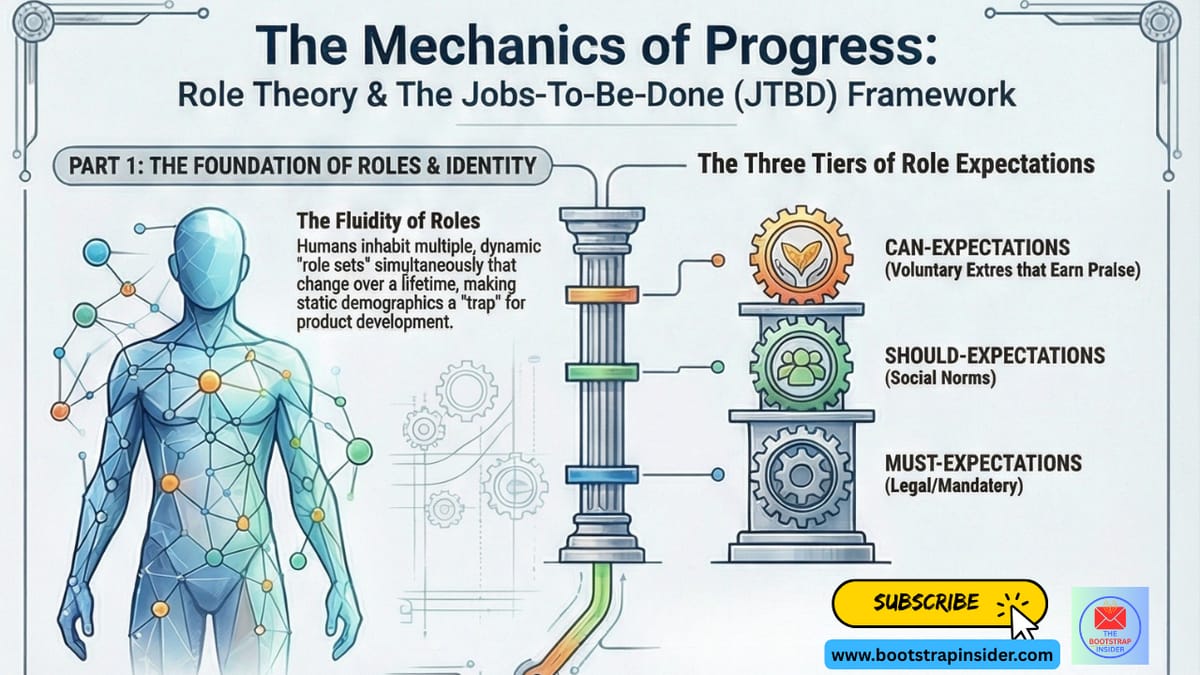
P.P.S. A lot of you have been asking about the JTBD poster I keep mentioning that hangs on my office wall. I went ahead and exported the high-res file for you.
You can download the full infographic for free right here. Print it out and use it as your daily cheat sheet!
Best,
Bartosz
Do you know a fellow bootstrapper who needs to read this?
Entrepreneurship can be lonely, but it doesn't have to be. If you enjoyed this story, forward it to a friend or co-founder who needs a little motivation today.
About The Bootstrap Insider
The Bootstrap Insider is a newsletter that helps startups discover and apply for pitch competitions, ensuring they never miss out on valuable opportunities. It addresses the problem of missed funding and exposure chances due to lack of information. Created by Bartosz Kajdas, an experienced entrepreneur, venture builder and Pitchtrainer, the platform leverages his expertise to provide timely and relevant updates.
Disclaimer:
This newsletter is for informational purposes only. We do not guarantee the accuracy or completeness of the information provided. We shall not be liable for any damages arising from the use or non-use of the information provided.